
Freeze-Dried Pet Food: Building a Profitable Production Line
Freeze-dried pet food has moved from a niche product to one of the fastest-growing segments in the pet market. Owners increasingly look for raw-style, high-protein food that is safe, convenient, and nutritionally intact. Freeze drying delivers exactly that: it removes water at low temperature, so the food keeps its natural structure, protein quality, and aroma while becoming shelf-stable without refrigeration. For pet food producers, a dedicated freeze-dried line is a way to enter a premium category with strong margins.
Why Freeze-Dry Pet Food
Conventional cooking and extrusion rely on heat, which can degrade nutrients and change the texture of the food. Freeze drying works differently. The product is frozen first, and the ice is then removed through sublimation under vacuum, so the raw ingredients keep more of their nutritional value and natural appearance. The result is a light, crisp food that rehydrates quickly when mixed with water or served directly. For raw and high-protein formulations, that combination is especially valuable.
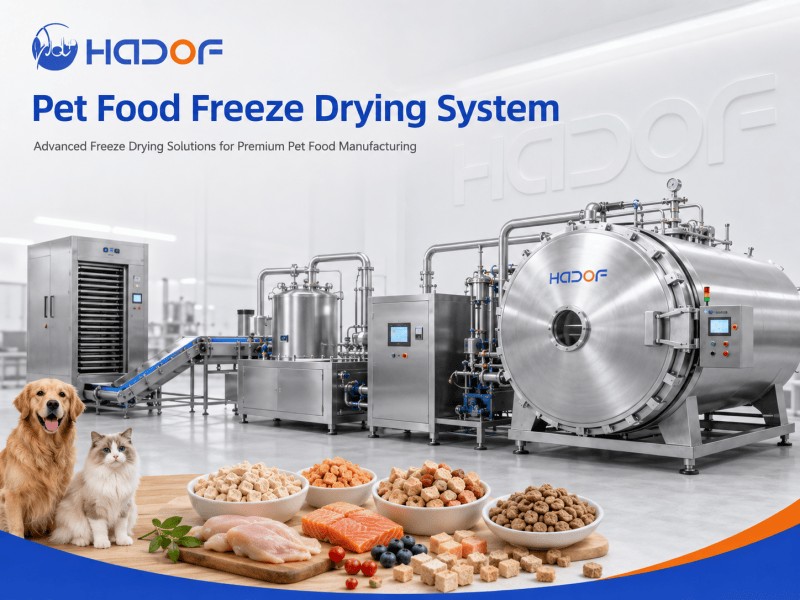
Pet Food Freeze Drying System
The Production Process
A commercial freeze-dried pet food line follows a consistent sequence:
- Raw material preparation — meat, organs, fish, and other ingredients are inspected, chilled, and prepared.
- Mixing and portioning — ingredients are blended to the recipe and formed into portions, patties, or pieces.
- Pre-freezing — the product is frozen quickly to protect texture and structure.
- Vacuum freeze drying — ice sublimates directly to vapor, preserving the food without high heat.
- Sorting and packaging — finished pieces are checked and packed in moisture- and oxygen-barrier packaging.
Each stage must be controlled. Slow freezing or uneven tray loading leads to uneven drying, and poor packaging lets the product absorb moisture and lose its crisp texture.
Equipment for the Line
The core of the line is the pet food freeze drying system, which is designed around the product’s freezing behavior and batch size. Around it, the line needs a pre-freezer or tunnel freezer, preparation and forming equipment, and a packing machine. The freeze dryer’s chamber, shelves, condenser, and vacuum system determine how much product you can process per cycle and how consistent the final moisture will be.
Because pet food formulations vary widely, flexibility matters. The line should handle different piece sizes and moisture levels, and the trays and contact surfaces must be easy to clean. If you plan to produce several recipes, look for a configuration that lets you change recipes and tray arrangements without rebuilding the line.
Capacity and Configuration
Capacity is usually specified by batch weight or shelf area. Producers often start with a batch size that matches their daily raw-material supply and then add capacity as demand grows. The right size depends on your product format, your drying cycle, and your target output. Under-sizing the dryer leaves product waiting; over-sizing it raises running costs. A practical approach is to size the industrial freeze dryer to a comfortable daily batch and plan the building so a second unit can be added later.
Food Safety and Quality Control
Pet food is a food product, and the same hygiene principles apply. Raw materials should be checked and kept cold, preparation areas should be separated from packing areas, and the freeze dryer should be easy to clean. The freeze-drying process should be logged for pressure, shelf temperature, and cycle time, and finished product should be tested for moisture and microbial safety. Traceability from raw material to finished bag is essential for retail and export markets.
Packaging and Shelf Life
Freeze-dried pet food is hygroscopic, so packaging is critical. Moisture- and oxygen-barrier bags, pouches, or tubs protect the product from humidity and oxidation. Nitrogen flushing can further extend shelf life. Correct packaging keeps the food crisp and stable for years, while poor packaging quickly leads to softening and flavor loss. Bag size and format are also marketing decisions, because pet owners buy both small trial packs and large value packs.
Common Mistakes to Avoid
The first mistake is using raw materials that are already losing quality; freeze drying preserves quality but cannot improve it. The second is freezing too slowly, which produces large ice crystals and damages texture. The third is overloading trays, which blocks vapor flow and creates uneven batches. The fourth is under-sizing the condenser, so the cycle slows down and energy use rises. Finally, skipping a proper packaging barrier undoes the benefit of freeze drying within weeks.
Conclusion
Freeze-dried pet food is a premium product with a clear market: raw-style nutrition, convenience, and long shelf life. The line is straightforward — prepare, portion, freeze, dry, and pack — but every stage must be designed around the product. HADOF Food Processing Manufacture designs complete production lines for freeze-dried pet food, from preparation and pre-freezing to the freeze dryer and packaging. Tell us your recipe and target output, and we will help you plan the right system.