
Tray loading thickness is one of the most overlooked settings in a freeze-drying line. Two factories can run the same product on the same chamber size and still see very different cycle times, and the difference often starts with how deeply each tray is filled. This article explains why loading thickness changes both drying time and batch uniformity, and how to match it to your material instead of copying a universal number. When you evaluate an industrial freeze dryer machine, the way trays accept load depth is a direct indicator of how well the line will fit your product.
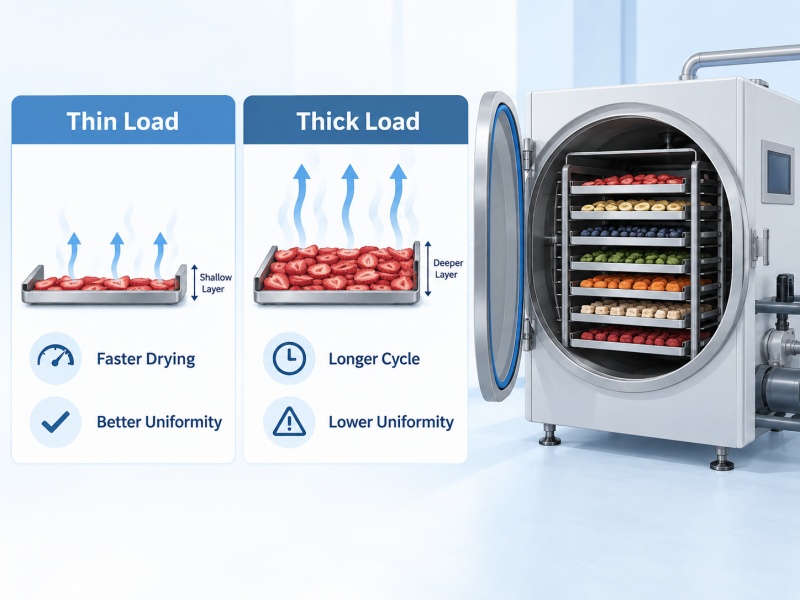
How Tray Loading Thickness Changes Freeze-Drying Time and Product Uniformity
Why Thickness Controls Drying Time
Sublimation happens at the surface of the frozen layer. Water vapor must escape from ice crystals below the surface and travel upward through the already-dried layer above it. A thicker load puts more material under a longer vapor path, so the drying front moves slower as the batch progresses. Doubling the depth does not double the drying time — it often stretches the cycle far more, because the dry layer acts as an insulating barrier that slows heat transfer into the frozen core.
Thinner layers reverse the effect. Vapor escapes quickly, heat reaches the ice front faster, and each tray finishes sooner. The trade-off appears in throughput: thinner loads mean more trays, more handling, and more loading cycles per batch. The right depth is therefore a balance between cycle time and the volume you need per batch, and it depends on the structure of your raw material.
How Thickness Creates Non-Uniform Batches
Uniformity suffers when trays are loaded unevenly. A deep tray next to a shallow tray dries at different speeds, so operators either extend the whole cycle to cover the slowest tray or accept under-dried product in the deepest zones. Under-dried pockets raise residual moisture, which shortens shelf life and can collapse the product structure during storage.
Particle size plays into this as well. Dice, slices, granules, and powders each pack differently in the same tray depth. A dense powder layer blocks vapor far more than loose slices at the same depth, which is why a thickness that works for one material can fail for another. Match the loading method to the material form, and keep depth consistent from tray to tray and from batch to batch.
Match Loading Depth to Your Material and Line
Rather than chasing a universal thickness value, work from your own material. Observe how it freezes, how it holds structure after pre-freezing, and how vapor moves through the dried layer during a test cycle. Adjust depth step by step and record how the end point of drying shifts. A 30kg batch freeze drying project gives you room to run these trials on a scale that translates directly to production.
As volumes grow, loading discipline matters even more. A 50kg/batch freeze dried food production line benefits from standardized scoops or spreaders that keep every tray at the same depth, so the whole chamber reaches its end point together. At the scale of a 100kg/batch industrial freeze drying plant, consistent tray depth becomes part of the batch record — it protects cycle predictability, simplifies operator training, and keeps product quality stable across shifts.
Practical Habits That Improve Both Time and Uniformity
- Weigh or volumetrically dose each tray so depth stays within a narrow band.
- Spread material to the corners; mounds in the center dry slower than the rest of the tray.
- Keep the load surface level, because an uneven surface changes the local sublimation area.
- Record loading depth with each batch so cycle data stays comparable over time.
These habits cost little, yet they shorten cycle times and make every tray finish closer to the same moment. Hadof designs drying chambers, tray systems, and loading tooling around the materials you process, so depth control becomes a repeatable routine instead of a daily guess. To discuss a customized line for your raw material, output target, and factory space, visit the Hadof freeze dryer homepage at https://www.freezehadof.com/.
hadof customized food handling factory