A 200kg/batch freeze drying production line fits factories that already ship dried product every week. Moreover, this capacity turns one dryer into a steady rhythm with matched upstream equipment. Hadof configures the whole line around your raw material, output target, and factory area.

200kg/batch Freeze-Drying Production Line
What Does a 200kg/batch Freeze Drying Production Line Deliver?
Because a 200kg/batch freeze drying line yields 200 kg of dried product, one shift stays busy. Besides, the dryer sits at the center, and washing, cutting, draining, and freezing stations feed it. Thus, material rarely waits between stations, and the chamber never idles for long. Then trays reload while the condenser defrosts, which keeps cycle time short. Therefore, daily output grows through tighter timing instead of a bigger machine.
When Does a Factory Outgrow a Smaller Chamber?
Small chambers work well while orders stay small and predictable. Trouble starts when one dryer becomes the slowest step in the day. Then operators wait for the chamber, and packing staff wait for product. Besides, three small dryers need three loading crews and far more floor space. The 100kg/batch industrial freeze drying plant covers steady mid-size orders, because one shift keeps it busy. Once daily demand passes that mark, a 200kg/batch freeze drying production line often costs less to run. Therefore, the switch point comes from order volume instead of ambition.
Which Materials Justify This Batch Size?
Fruit, vegetables, meat, seafood, and coffee extracts all fit this capacity. However, moisture content decides how much dry product leaves the chamber. For example, fruit carries far more water than meat, so dry yield differs. Pet treats and ready-meal pieces also run here, because protein loads freeze fast. What’s more, one recipe library stores settings for every product family. So operators switch between products without fresh trial batches. One 100 m² freeze dry equipment frame covers mid-size orders, while this line adds matched capacity upstream.
How Does Material Move From Raw Intake to Sealed Pack?
Nine steps carry material from raw intake to sealed pack. First, operators sort and clean the raw material, so defects leave early. Next, washing equipment removes soil, dust, and surface residue. After that, cutting machines give uniform slices, cubes, or strips. Draining then removes surface water before tray loading. So every tray holds the same depth, and freezing stays even. Pre-freezing comes next, because fast cooling keeps ice crystals small. Afterwards, vacuum drying removes that ice without heat damage. Finally, inspection and packaging close the cycle under low humidity.
What Equipment Makes Up the Complete Line?
One complete line joins six module groups, and you buy them in stages. Because every module matches the next one in capacity, material flows without pile-ups. You can order each group alone or as a complete freeze drying production line.
- Pre-treatment Equipment
Pre-treatment covers bubble washing, roller brush washing, eddy current cleaning, and high pressure units. What’s more, vibrating dewatering machinery and air dryers remove surface water before freezing. Manual sorting platforms then keep quality checks in your own hands.
- Cutting Equipment
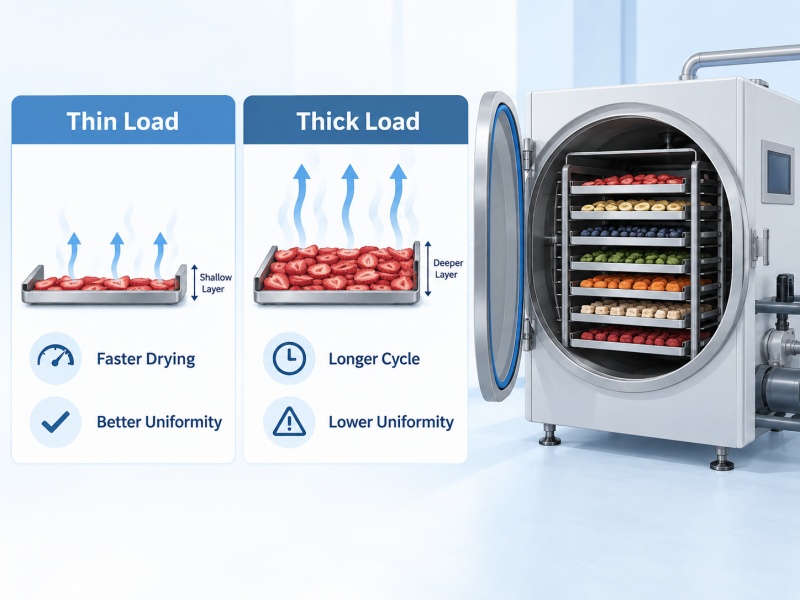
Cutting machines cover vegetable slicers, leafy vegetable slicers, dicers, and strip cutters. Piece size then follows each recipe, so every piece freezes at the same speed. Also, uniform pieces shorten the drying cycle, because thick and thin pieces dry at different rates.
- Freezing Equipment
Freezing equipment ranges from industrial tunnel freezers to IQF spiral freezers and liquid nitrogen units. An integrated cold room also pre-freezes loaded trays before they enter the chamber. Such a fast temperature drop locks the cell structure, so texture stays firm after drying.
- Conveying Equipment
Belt conveyors and bucket elevators link every station along the line. Meanwhile, steady flow keeps the freezer and the dryer working at one pace. As a result, one crew covers several stages instead of one station.
- Vacuum Freeze Drying Equipment
The core module carries the HDF-100 vacuum freeze drying machine, with 100 m² of shelf area across 17+1 layers. That chamber holds a reference fresh load near 1,000 kg per batch, so the 200kg/batch target keeps headroom. Each chamber also carries a vacuum pump and compressor set. Its condenser holds -40 °C or -60 °C, and the refrigerant is R507A.
- Packing Equipment
Packing equipment closes the workflow, and it seals finished product under low humidity. In addition, metal detectors check final packs before shipment. Your whole line then runs with a small crew and one control cabinet.
Which Parameters and Utilities Should You Compare?
Water load matters more than shelf count, because moisture varies from product to product. Ask for water capture figures on a 200kg/batch freeze drying production line before you compare two machine sizes. Ultimate vacuum below 5 Pa protects aroma and nutrients, because water leaves without heat damage. Moreover, shelf temperature uniformity within ±1 °C keeps color and shape even across the load. Its dual compressor pushes the condenser to -40 °C or -60 °C for heat-sensitive recipes. PLC control stores recipes, and it shows pressure, temperature, and time in real time. Also, plan utilities early, because this class of line draws serious power.
| Parameter | Value for a 200kg/batch line |
| Batch target | up to 200 kg of dried product per batch |
| Drying module | HDF-100, 100 m² of shelf area (17+1 layers, 70 mm spacing) |
| Reference fresh load | about 1,000 kg per batch |
| Water capture capacity | ≥2,000 kg per batch |
| Ultimate vacuum | ≤5 Pa |
| Condenser temperature | -40 °C or -60 °C with a dual compressor |
| Shelf temperature uniformity | ≤±1 °C |
| Installed power | 260 kW (compressor 180 kW) |
| Heating method | Superheated steam |
| Body material | SUS304 food-grade stainless steel |
| Power supply | 380 V, 3 phase, 50 Hz |
| Defrost mode | Spray water defrost |
| Refrigerant | R507A |
| Control | PLC and touch screen with recipe storage |
| Pre-freezing | Integrated cold room or a tunnel freezer |
How Do You Plan Cost and Site Layout?
Cost follows configuration, so you compare modules before you compare quotations. Machine size, refrigeration package, steam source, and control level all move the total. Cold-chain recipes need the dual compressor option, which adds to the package. So request a cost breakdown by module before you fix a budget.
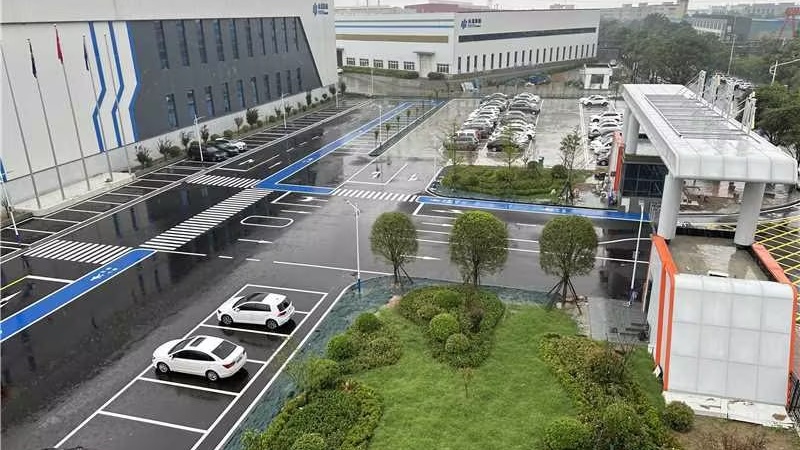
Site planning then decides how smoothly the line runs after installation. You divide the building into a wet zone for washing and cutting, and a dry zone for drying and packing. If your frame runs long, you check clear height and floor loading first. Meanwhile, reserve space for the steam source, the cold room, and the control cabinet. Power supply runs at 380 V, three-phase, 50 Hz, so you confirm the incoming capacity. Water cooling also needs a chiller loop or a cooling tower. Truck access and door width then decide how the chamber arrives on site.
Why Match Every Station to One Batch Schedule?
Your line runs best on one steady rhythm, so uptime and quality both hold. When the freezer outruns the dryer, frozen trays pile up near the door. Those trays then pick up frost, and frost changes load depth between batches. If packing lags, dried product regains moisture and loses crunch. Meanwhile, an idle chamber still draws standby power and occupies a crew. Therefore, capacity matching across washing, cutting, freezing, drying, and packing decides your real daily output.
Hadof is a professional food processing equipment manufacturer. Our factory builds pre-treatment, washing, cutting, freezing, air drying and freeze drying equipment. Moreover, our engineers design complete lines instead of single machines. We also hold ISO9001 and CE certification, and we serve freeze drying projects worldwide.
A dedicated engineer studies your raw material, output target, and factory area, so the layout fits your building. Besides, our team handles installation, commissioning, and operator training after delivery. You can contact our team at any time.
For a customized solution, visit the Hadof freeze dryer homepage at https://www.freezehadof.com/.