
An industrial freeze dryer is a long-term production asset, so the purchase price alone does not show the full investment. Two machines with the same outer dimensions can have very different vacuum systems, refrigeration packages, controls and food-processing features. Buyers also need to include preparation equipment, installation, utilities and spare parts when comparing quotations.
This guide explains the main cost factors behind an industrial freeze dryer, how capacity changes the budget, and how food manufacturers can compare suppliers on a like-for-like basis.
Why Industrial Freeze Dryer Prices Vary So Much
Freeze drying removes water through sublimation rather than high-temperature evaporation. The chamber must first freeze the product, then maintain a suitable vacuum while controlled heat drives moisture from the ice. Every subsystem therefore affects both performance and price.
The largest variables are batch capacity, shelf area, condenser temperature, vacuum performance, heating method, automation level and construction standard. A machine designed for sliced fruit may not be suitable for dense meat, liquid coffee extract or a product that needs precise recipe control.
Supplier scope also matters. One quotation may include only the dryer, while another may include washing, cutting, blast freezing, conveying, packaging, installation, training and spare parts. A low equipment price is not necessarily the lowest project cost if essential items are added later.
Reference Budgets by Freeze Dryer Capacity
Industrial freeze dryer prices generally rise with shelf area and batch capacity, but they do not rise in a perfectly linear way. Larger systems use more steel, refrigerant, vacuum capacity and control hardware, while compact machines often carry a higher cost per kilogram because basic components remain necessary at every scale.
The following reference ranges help with early budget planning for food processing equipment:
- 1 m² shelf area, approximately 10 kg per batch: USD 18,000–20,000
- 3 m² shelf area, approximately 30 kg per batch: USD 30,000–40,000
- 5 m² shelf area, approximately 50 kg per batch: USD 50,000–60,000
- 10 m² shelf area, approximately 100 kg per batch: USD 60,000–70,000
- 20 m² shelf area, approximately 200 kg per batch: USD 75,000–85,000
- 50 m² shelf area, approximately 500 kg per batch: USD 140,000–150,000
- 100 m² shelf area, approximately 1,000 kg per batch: USD 290,000–320,000
These figures are planning references, not final quotations. Material density, moisture content, tray loading depth, drying-cycle length and factory conditions can change the required configuration. A 100 kg/batch machine, for example, does not process 100 kg every hour. Daily output depends on the complete cycle and the number of batches completed each day.
What Drives the Cost Beyond Capacity
Vacuum and Refrigeration Performance
The vacuum pump, valves, leak-tight chamber and cold trap are central to stable sublimation. A system that must reach and hold a deeper vacuum may require stronger pumps and more precise controls. Condenser temperature is equally important because it determines how effectively water vapour is captured.
Buyers should ask for performance data at the intended operating conditions. Requesting only the chamber size can result in quotations that appear comparable but differ significantly in vacuum capacity, refrigeration reserve and achievable cycle time.
Product-Specific Process Design
Fruit, vegetables, meat, seafood, pet food and coffee do not dry in the same way. Sugar-rich fruit can require different pre-freezing and heating strategies from dense meat or liquid extracts. Uniform tray loading is also important because excessive thickness can lengthen primary drying and create uneven moisture.
Edible products usually require food-grade stainless steel, accessible cleaning surfaces and hygienic transfer points. These details increase cost compared with a basic industrial chamber, but they reduce contamination risk and support consistent product quality.
Controls, Automation and Energy Efficiency
Basic relay controls may be sufficient for a small operation, while larger plants often need recipe management, data logging, alarm history, remote support and automatic pressure or temperature ramping. Better automation can reduce operator error and improve repeatability, but it should match the skills and maintenance resources of the factory.
Energy design also affects total cost. Efficient refrigeration, correctly sized pumps, good insulation and optimized heating can reduce electricity use over the life of the machine. The lowest purchase price may therefore lead to higher operating costs if the system is poorly matched to the product and production schedule.
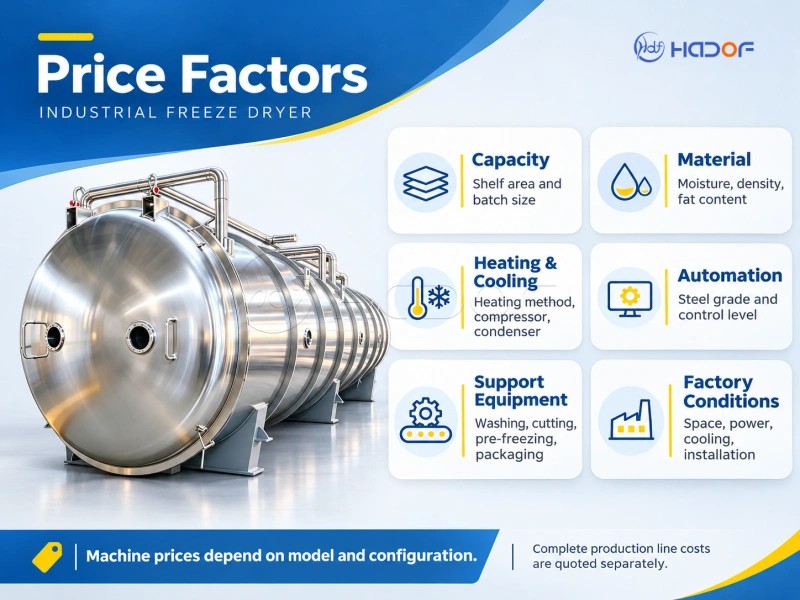
price factors of freeze drying equipment
Equipment and Installation Costs Outside the Dryer
A complete freeze-drying production line can include sorting, washing, peeling, cutting, blanching, pre-freezing, conveying and packaging. Each stage adds capital cost, but it can improve yield, labour efficiency and product consistency.
Project budgets should also include:
- Shipping, insurance and import duties
- Factory preparation and floor-loading requirements
- Electrical supply, cooling water or chiller connections
- Compressed air and drainage where required
- Installation, commissioning and operator training
- Initial spare parts and maintenance tools
- Product trials and process-recipe development
For example, a 50 kg/batch fruit project may have a dryer price within one range but a higher delivered project cost once washing, cutting, a −40°C blast freezer, conveyors and installation planning are included. A published 50 kg/batch fruit freeze-drying line cost case shows why buyers should compare complete scopes rather than isolated machine prices.
How to Size the Machine for the Real Production Target
HADOF uses approximately 10 kg of raw material per square metre as an initial shelf-area reference. A 10 m² machine therefore represents roughly a 100 kg batch, while a 20 m² machine represents approximately 200 kg.
This is only a starting point. A more reliable calculation starts with daily finished-product demand, expected moisture reduction, usable tray area, loading depth and verified cycle time. Product trials are especially valuable for high-sugar fruit, thick meat pieces, mixed ready-meal components and liquid concentrates.
Use the freeze dryer capacity guide to estimate batch size, but confirm final capacity with samples. Buying extra capacity that is never used increases initial cost, while buying too little can create bottlenecks during harvest or peak order periods.
Practical Ways to Control the Budget
Start with a clear product specification and realistic output target. Choose a standard model where it meets the process, then add automation or custom features only where they solve a defined problem.
Plan the factory layout early. Allow enough space for loading, unloading, cleaning, maintenance access and future expansion. Modular dryers can support staged growth without constructing a completely new plant.
Finally, compare quotations using the same scope, performance targets and warranty terms. Ask each supplier to list the included equipment, utility consumption, installation responsibilities, commissioning plan, spare-parts package and expected support response.
Procurement Checklist
Before approving an industrial freeze dryer budget, confirm the raw materials, batch weight, tray dimensions, target moisture, acceptable cycle time, daily operating hours and packaging plan. Ask for the condenser temperature, vacuum level, shelf-temperature range, utility requirements, control functions and material certifications.
Also request references from a similar food application and inspect the proposed cleaning and maintenance access. The best-value machine is the one that reaches the required product quality consistently, fits the factory infrastructure and remains serviceable throughout its operating life.
For capacity-based pricing, complete production-line planning and a configuration matched to your food product, contact HADOF Food Processing Manufacture with your raw material, required batch size and finished-product specification.