
An NPK fertilizer blending project may look straightforward, but equipment selection depends on more than the required output. You need to consider whether the plant will process powders, finished granules, or both. Formula frequency, packaging specifications, dust control, automation, and future expansion also influence the final configuration.
For investors serving several agricultural markets, an NPK fertilizer blending plant designed for powder and granule formulas provides greater production flexibility. However, powder and granular materials behave differently during batching, conveying, mixing, and packaging. A successful project therefore begins with the product form and sales plan rather than an equipment list.
Start With the Fertilizer Products You Plan to Sell
NPK products contain nitrogen, phosphorus, and potassium in formulas selected for particular crops and soil conditions. They belong to the broader category of multinutrient fertilizers, but their physical forms can differ considerably.
Powder fertilizer production normally requires accurate batching, intensive mixing, enclosed conveying, and effective dust collection. Fine materials can escape at transfer points, while differences in bulk density may affect the consistency of the finished mixture.
Granular BB fertilizer production has another priority. The system needs to combine finished granules without excessive crushing. Similar particle sizes also help limit segregation during mixing, storage, transport, and bagging.
If your business plans to sell both products, an automatic batching and mixing system for blended NPK fertilizer can use separate process settings and suitable material-contact components for each production campaign.
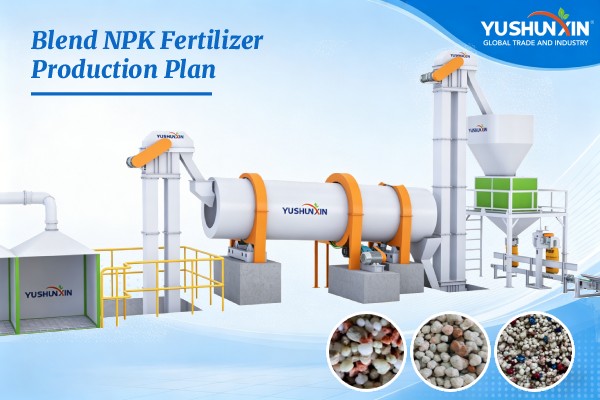
blend NPK fertilizer production solution
Match the Batching System to Formula Frequency
How often will your plant change fertilizer formulas?
A producer supplying only one or two standard products may use a relatively simple static batching arrangement. A factory serving distributors, plantations, or seasonal crop markets usually needs more raw-material bins and faster recipe adjustment.
Each bin can store a separate material such as urea, DAP, MAP, MOP, or ammonium sulfate. Weighing sensors measure the required quantity before the materials enter the mixer. The control system then manages the selected recipe and production batch.
This arrangement makes a flexible NPK blending line for changing fertilizer recipes particularly useful when a factory produces several nutrient grades. It also reduces the need to rearrange equipment whenever the sales department introduces another formula.
Select the Mixer According to Material Form
The mixer affects product uniformity, particle condition, cleaning time, and production continuity.
Horizontal, single-shaft, or double-shaft mixers suit many powder fertilizer projects because they create strong material movement. Enclosures and dust-collection connections can control powder released around the inlet and discharge points.
BB fertilizer mixers and rotary drum blenders suit granular materials. Their tumbling action combines the granules while limiting aggressive mechanical contact. A drum arrangement can also support continuous production at medium or large capacities.
For a practical capacity reference, the 10 TPH bulk blending fertilizer factory configuration combines multi-bin batching, belt conveying, drum mixing, buffer storage, and automatic bagging.
Coordinate Mixing and Packaging Capacity
A high-capacity mixer cannot maintain its rated output when the packaging section operates too slowly. The batching, mixing, conveying, buffer storage, and bagging units need compatible capacities.
A finished-product bin between the mixer and packing machine can stabilize material flow. It allows the mixer to begin another cycle while the packaging system handles the previous batch. This arrangement reduces waiting time between the main processing stages.
When planning an industrial fertilizer blending plant with integrated packaging, confirm the required bag sizes, weighing accuracy, sealing method, daily working hours, and desired automation level. The answers determine whether the project needs a single packing scale, double weighing units, automatic bag feeding, or robotic palletizing.
Consider Cleaning, Corrosion and Future Expansion
Frequent formula changes make cleaning access especially important. Residue inside bins, conveyors, mixers, and buffer hoppers may enter the following production batch. Accessible inspection doors and an organized cleaning procedure help the factory manage product changeovers.
Material selection also matters. Carbon steel can suit many standard applications, while stainless steel contact parts may offer advantages for corrosive materials or projects with stricter cleaning requirements.
Some investors begin with physical blending and later add coating or granulation equipment. Powder mixtures can enter dry roller compaction or a wet granulation process, while finished granules can receive functional coatings. Leaving suitable floor space and conveyor interfaces during the first installation can make later expansion easier.
Prepare the Right Information Before Requesting a Proposal
Equipment suppliers can develop a customized NPK fertilizer mixing factory solution more efficiently when the project information is complete. A useful inquiry includes:
- Raw-material names and physical forms
- Number of fertilizer formulas
- Required output per hour
- Planned working hours per day
- Powder or granular finished product
- Bag sizes and packaging requirements
- Available workshop dimensions
- Local power supply
- Required automation level
- Future coating or granulation plans
You can learn more about available capacity ranges and equipment combinations before preparing your project request.
For equipment selection and layout planning, submit your raw materials, target capacity, product form, bag size, and workshop dimensions through: https://www.mixedfertilizermachines.com/products/npk-fertilizer-blending-plant/